Earning the trust of 20+ employers for a new college serving adult learners
Earning the trust of 20+ employers for a new college serving adult learners
Role
Service Designer
Skills
Service Design
UX Research
Implementation
Duration
4 months design
6 months implementation
Role
Service Designer
Duration
4 months design
6 months implementation
Skills
Service Design
UX Research
Implementation
Context
Context
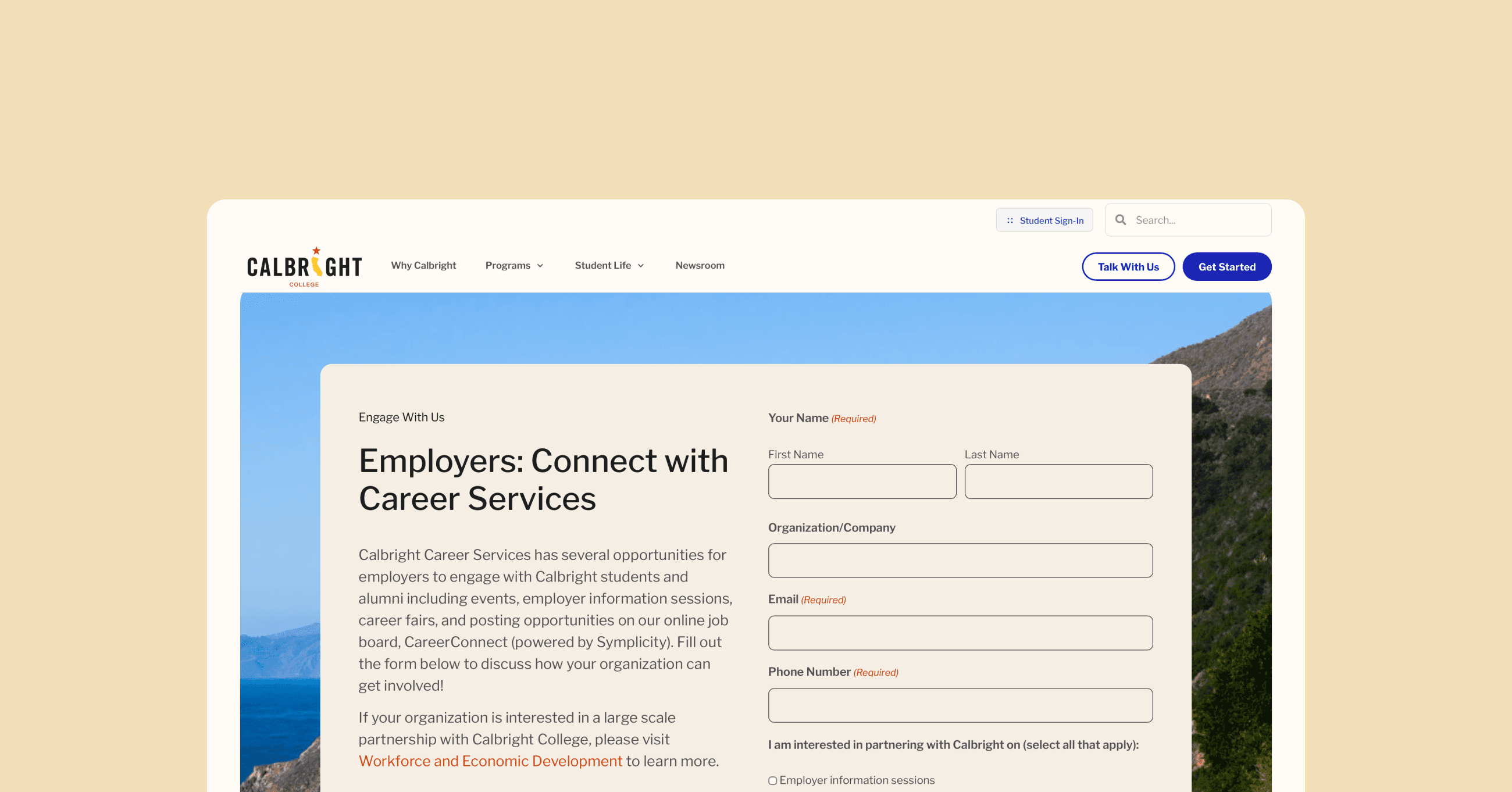
Calbright College is California's first free, fully online community college, offering skills-based education to adult learners. As a career-focused college, it needed employer partners who could share job opportunities and host events for students.
My role was new, so I started from a blank slate with no process, partnerships, or history. I led the research, design, and final strategy, with help hosting some of the discovery calls.
Calbright College is California's first free, fully online community college, offering skills-based education to adult learners. As a career-focused college, it needed employer partners who could share job opportunities and host events for students.
My role was new, so I started from a blank slate with no process, partnerships, or history. I led the research, design, and final strategy, with help hosting some of the discovery calls.
Impact
Impact
I implemented Calbright's first ever employer experience strategy. A focus on genuine conversations turned more than half of meetings into student engagements within two months.
Within six months, I secured Calbright's first 20+ employer partners, who posted jobs, joined speaker panels, and hosted events for students, which garnered >90% satisfaction from post-event surveys.
I implemented Calbright's first ever employer experience strategy. A focus on genuine conversations turned more than half of meetings into student engagements within two months.
Within six months, I secured Calbright's first 20+ employer partners, who posted jobs, joined speaker panels, and hosted events for students, which garnered >90% satisfaction from post-event surveys.
For non-traditional, adult learners who are historically left behind.
For non-traditional, adult learners who are historically left behind.
Problem
Problem
Employers didn't know us or what we offered students.
Employers didn't know us or what we offered students.
Employers had never heard of us, and our certificates weren't degrees. In the first ten months, only two employers ever reached out to us first, which is the most common way older institutions create connections.
Employers had never heard of us, and our certificates weren't degrees. In the first ten months, only two employers ever reached out to us first, which is the most common way older institutions create connections.
Research
Research
We went to employers to find out where the gaps were.
We went to employers to find out where the gaps were.
I ran 12 discovery calls with employers, then led an affinity mapping session that sorted what we heard into six themes. Most didn’t know what our certificates meant or what partnering with us would look like.
Large employers’ rigid requirements, like four-year degrees or specific class years, also couldn’t flex for a competency-based college. So I directed outreach toward small and mid-sized businesses, which became most of our partners, followed by staffing agencies.
I ran 12 discovery calls with employers, then led an affinity mapping session that sorted what we heard into six themes. Most didn’t know what our certificates meant or what partnering with us would look like.
Large employers’ rigid requirements, like four-year degrees or specific class years, also couldn’t flex for a competency-based college. So I directed outreach toward small and mid-sized businesses, which became most of our partners, followed by staffing agencies.

Design
Design
I designed for the first reply, then for a lasting relationship.
I designed for the first reply, then for a lasting relationship.
Next, I mapped the employer journey from first awareness to advocacy. I assumed the hardest stage would be Conversion, the moment an employer commits. Outreach proved me wrong: the real wall was Consideration, getting any reply at all.
I started tailoring each message to the roles, programs, or mission that mattered to each employer, and that is what began to earn replies.
Next, I mapped the employer journey from first awareness to advocacy. I assumed the hardest stage would be Conversion, the moment an employer commits. Outreach proved me wrong: the real wall was Consideration, getting any reply at all.
I started tailoring each message to the roles, programs, or mission that mattered to each employer, and that is what began to earn replies.

To guide employers from that first reply to an active partnership, I designed an employer flow. My first draft included a full menu of ways to partner, like hosting info sessions or posting on our job board. It was meant to simplify things, but it felt transactional, and I wanted to instead focus on relationships.
I scrapped the menu and introduced options in conversation, based on what each employer needed. It helped most with employers still deciding on us, and partners told me they noticed and appreciated it.
To guide employers from that first reply to an active partnership, I designed an employer flow. My first draft included a full menu of ways to partner, like hosting info sessions or posting on our job board. It was meant to simplify things, but it felt transactional, and I wanted to instead focus on relationships.
I scrapped the menu and introduced options in conversation, based on what each employer needed. It helped most with employers still deciding on us, and partners told me they noticed and appreciated it.

Outcomes
Outcomes
A win-win situation for students and employers.
A win-win situation for students and employers.
For Calbright
For Calbright
I launched a full strategy for the employer experience. This was slated to be a first-year pilot and reassessed at milestones. Over the first six months, it was slow to start but only ramped up. Employers were sharing about their engagement on LinkedIn and added new, organic leads as well.
I launched a full strategy for the employer experience. This was slated to be a first-year pilot and reassessed at milestones. Over the first six months, it was slow to start but only ramped up. Employers were sharing about their engagement on LinkedIn and added new, organic leads as well.
For students
For students
Employer-supported events were among Calbright's most popular engagements. Participants responded positively to every event I ran, and employers sent positive messages afterward.
Employer-supported events were among Calbright's most popular engagements. Participants responded positively to every event I ran, and employers sent positive messages afterward.
For employers
For employers
Anecdotally, employers loved working with our students. Being an asynchronous, online college, participation was opt-in, so students who attended events or connected with employers were always motivated and prepared for meaningful conversations.
Employers were able to expand their candidate pools and share their name with students across California who might not have heard of them before.
Anecdotally, employers loved working with our students. Being an asynchronous, online college, participation was opt-in, so students who attended events or connected with employers were always motivated and prepared for meaningful conversations.
Employers were able to expand their candidate pools and share their name with students across California who might not have heard of them before.

Reflection
Reflection
What I learned
What I learned
Stay close to those who champion your mission
Stay close to those who champion your mission
Genuine and flexible conversations with employers about their needs and how we could be the best partners allowed us to provide exceptional experiences that other colleges were not. Our employer champions, those who loved and shared about working with us, helped us invaluably to magnify our awareness. They posted and talked about their experience, bringing in others from their circles.
Genuine and flexible conversations with employers about their needs and how we could be the best partners allowed us to provide exceptional experiences that other colleges were not. Our employer champions, those who loved and shared about working with us, helped us invaluably to magnify our awareness. They posted and talked about their experience, bringing in others from their circles.