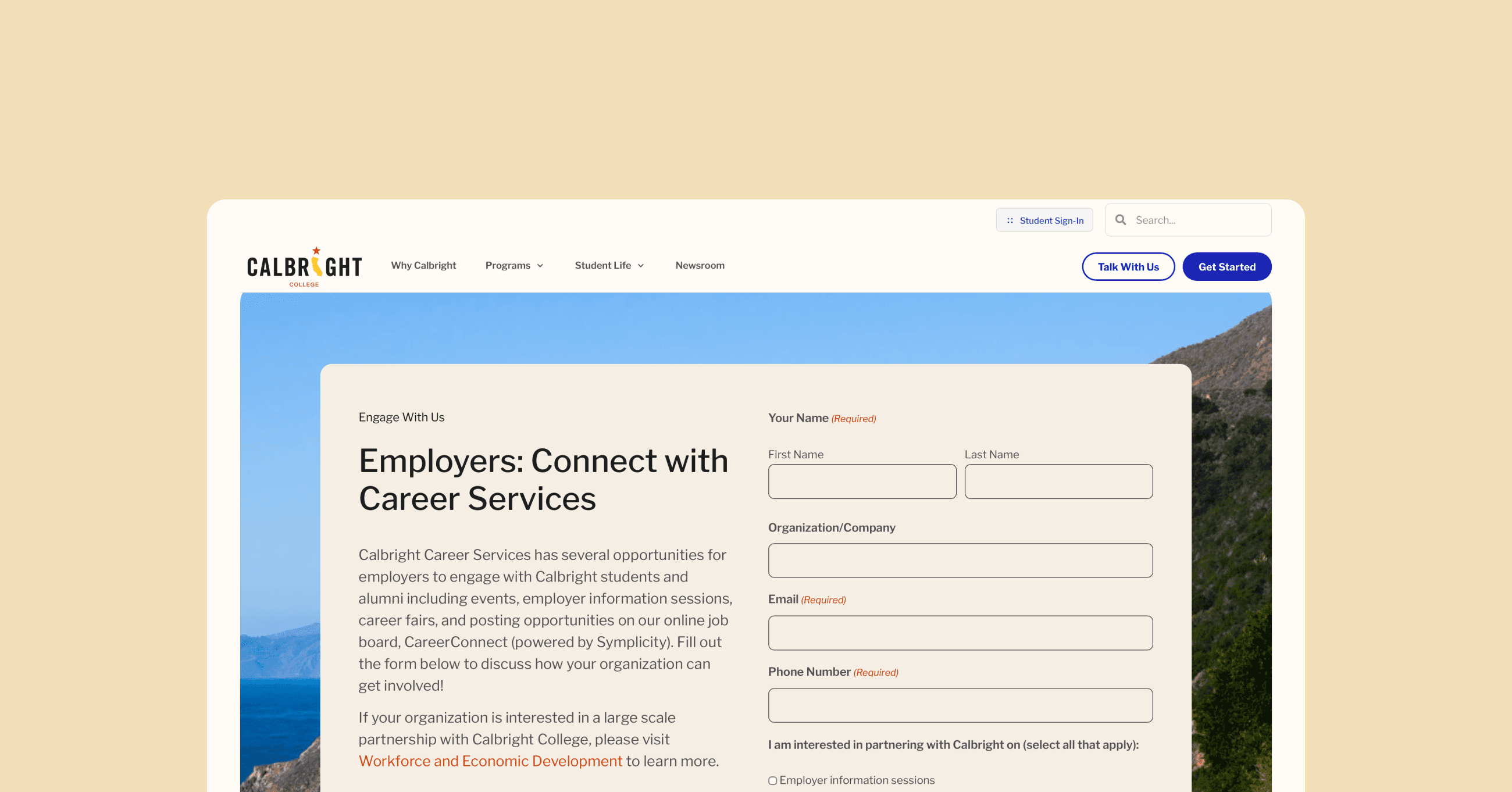
How might we build employer partnerships that create career opportunities while establishing Calbright as a credible institution worth partnering with?
The Problem
Employers in California had no clear, consistent way to connect with Calbright and reach its students. Without an employer experience, Calbright risked missing partnership opportunities and limiting career outcomes for students.
Research and Discovery
Over several weeks, I combined competitor analysis, employer discovery calls, and internal team interviews to ground the strategy in real needs.
Competitor Analysis
I looked at two schools with very different employer programs: a fully-online institution and a highly recognized university. The online school actively sold its students while the other had much less info. Calbright, without name recognition or an alumni network to lean on, pushed me toward building an outreach framework highlighting our students and academic programs.
Internal Team Interviews
Interviews with external-facing teammates revealed that teams were operating in silos, with no shared visibility into who was talking to whom. It was obvious we needed a shared CRM, which led to the HubSpot implementation covered in Results.
Following internal interviews, this actually revealed a third problem: Internal teams had no way to track and share outreach efforts or partnership progress to avoid duplicate efforts and leverage existing relationships.
Employer Discovery Calls
Within a three to four week window, we set up 12 calls with employers across industries to understand their hiring needs and how they viewed community college. Two findings stood out. Employers were largely unfamiliar with certificates as a credential, so we couldn't assume the qualification spoke for itself. And larger companies tended to have rigid requirements, like hiring only from four-year programs or specific class years, that we had no way to work around. That pointed us toward small to medium-sized businesses, who had more flexibility and more to gain from a wider talent pool.
After the calls, I led an affinity mapping session with the team, grouping insights into six topic areas: hiring needs, current practices, engagement preferences, perception of Calbright, barriers, and opportunities.

Design
I translated the research into three artifacts: personas, a journey map, and an employer flow. Each one visualized a different part of the employer experience for the team to build a shared understanding and find where to focus.
Persona Development
I built three personas to represent types of companies that might recruit from a community college. In practice, this helped us identify a strong first contact at each one.


Journey Map
I mapped the employer journey across five stages, capturing The Overshadowed HR Manager's thoughts, emotions, and actions.

Early on, we put most of our attention on Conversion. As a new college with no existing employer relationships, getting employers to commit to a partnership felt like the biggest hurdle. Once we started outreach, it turned out we had it backwards: Consideration was the hard part, getting any response to cold outreach at all. Once an employer was in a conversation with us, scheduling an actual engagement was rarely the problem.
Employer Flow
The employer flow mapped the ideal path from first outreach to an active partnership, showing the decision points along the way. The path didn't end at the first collaboration. Once a partner committed to one type of action, whether posting jobs, hosting an info session, or joining a panel, the relationship fed back to the start to build toward the next engagement.

As part of building the flow, I developed a full menu of services defining how employers could work with us. In theory, it would simplify partnerships by giving employers a clear set of options upfront. In practice, it felt transactional and less relationship-focused, which was a top goal of ours. I removed it and shifted to introducing options conversationally based on what each employer actually needed, which was especially helpful with employers who were still figuring out whether Calbright was a fit at all.
Results
Within six months of putting the strategy into practice, Calbright had a repeatable way to reach employers, high-engagement student events, and a shared system to manage it all.
Partnerships
From February 2025 onward, I used the strategy to guide all employer outreach. We contacted over 280 employers and achieved a 10%+ response rate, which is strong for cold outreach in higher education. Of those who responded, around 20 became active partners, posting jobs, joining panels, or hosting events with us. The mix skewed toward small to medium businesses, which aligned with our research, with staffing agencies as the second most common partner type.
Events
Employer-supported student events were consistently our most popular touchpoint, drawing the highest attendance and engagement. Post-event surveys on Zoom showed 90%+ satisfaction, which is why we made them a core part of the engagement model.
Systems
HubSpot was fully adopted across all five teams and remains active. I became a power user for Career Services and met regularly with power users from the other teams for about six months after implementation to make sure things were running smoothly. The biggest shift was giving everyone shared visibility into employer relationships, which was the core problem we found in our internal interviews.

Reflection
Looking back, I should have found a way to keep employers involved through more steps of the process. Discovery calls gave us initial direction, but once we moved into building the strategy and the flow, we were working off early insights without continuous feedback from employers.
Keeping engagement opportunities flexible was the right call for Calbright, but it came with tradeoffs. An open-ended approach comes off warm and tailored, but can be harder to scale than a more standardized process. Initial outreaches and follow-up emails could become standard steps, while partnership conversations and ways to engage stay adaptable. The next design challenge is balancing scalability while staying true to the warmth and effort that builds these relationships in the first place.
Next Steps
Design for first impressions. Getting an initial response to cold outreach was the hardest part of implementation. It would be beneficial to test what emphasis earns the highest response rates and/or if it depends on the type of employer. After initial meetings, we converted over 50% into student engagement opportunities within two months.
Tie engagement to student outcomes. The current metrics measure employer activity, but the real goal is jobs for students. Connecting partnerships to actual placements would measure employer relations on the outcome that matters most.
Continue increasing awareness. Over a year, we had only two employers outreach to Calbright first. Both of them became repeat partners. Every employer met through cold outreach had never heard of Calbright previously, and that limits the amount of relationships we can build without always engaging first.